In April of 2025, HHS secretary RFK Jr. stated:
“The autism epidemic is running rampant,” said U.S. Health and Human Services (HHS) Secretary Robert F. Kennedy, Jr. “One in 31 American children born in 2014 are disabled by autism. That’s up significantly from two years earlier and nearly five times higher than when the CDC first started running autism surveys in children born in 1992. Prevalence for boys is an astounding 1 in 20 and in California it’s 1 in 12.5.”
This remains the official position of the HHS and is stated on their website. RFK went on to describe how devastating autism is, saying that:
“These are kids who will never pay taxes, they’ll never hold a job, they’ll never play baseball, they’ll never write a poem, they’ll never go out on a date. Many of them will never use a toilet unassisted.”
The problem is – he is making a basic error, which is shocking for someone in his position and the resources that come with it. RFK is using data for autism spectrum disorder (ASD) as if it applies to people with profound autism. These are, however, clearly two distinct entities, even though they are both classified under the broad umbrella of “autism.”
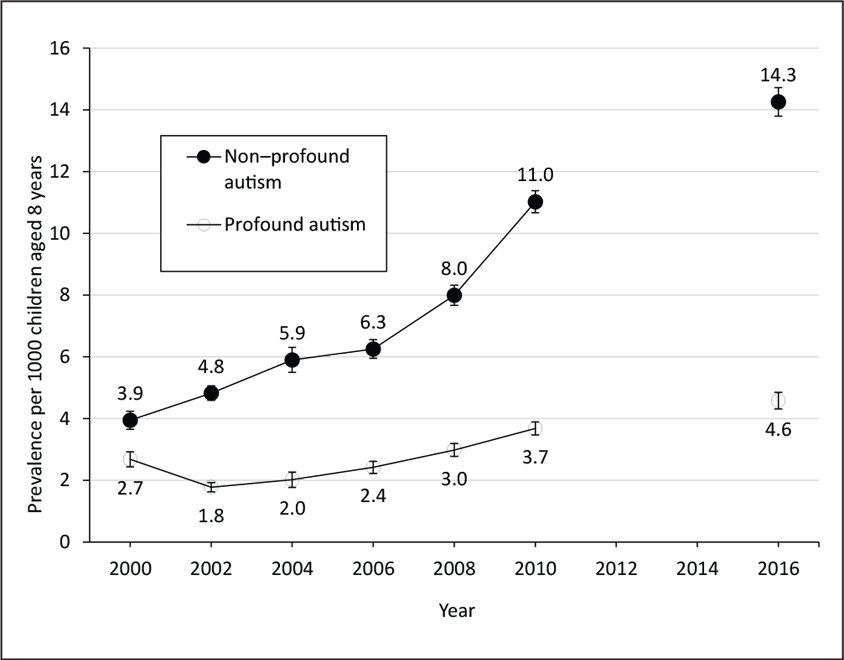
Profound autism refers to people who are non-verbal, minimally verbal, or who have an IQ <50. In other words, they have profound intellectual disability, and by any reasonable definition are disabled. A 2023 study found that 26.7% of 8-year olds with ASD had profound autism, which means that 73.3% did not. Many of those with non-profound ASD have subtle manifestations only, are not disabled, and lead productive lives. Many of them consider themselves to be “neurodiverse”, with a different set of strengths and weaknesses from those who are more neurotypical. Some may still need some services and accommodations, but that hardly makes them “disabled”.
Anti-vaxxers like RFK Jr have been using the increasing number of children identified with autism (which is the accurate way to refer to such statistics) to raise the alarm about an “autism epidemic”. However, as we have documented here many times, there is no reason to conclude that there is an actual autism epidemic – it does not exist.
What the data show is that over the last 30 years there are at least three factors that contribute to an increase in the number diagnosed, even without a true increase in incidence. First, the definition has been broadened (hence the term “spectrum”), and has absorbed other diagnoses, such as Aspergers Syndrome and pervasive developmental delay. Sometimes this is referred to as diagnostic substitution.
Second, surveillance efforts have increased dramatically. More children are getting formal testing for autism, for example. Autism diagnoses also tend to follow the availability of services for children with autism. Generally speaking, if you look for something more, you will find it more.
Further, having an autism diagnosis is now considered much more socially acceptable, with less associated stigma, than in the past. This correlates with greater community awareness of the diagnosis and the services available. The bottom line is that 30 years ago many children who today would be diagnosed with ASD would have just been considered “odd”, not formally tested, not identified or diagnosed, and not provided any services or accommodations. Many others would have been given alternate diagnoses. These factors combined are capable of explaining the rise in autism diagnoses. In other words – there is no true epidemic.
If we focus on profound autism we see a different picture. There has been some diagnostic substitution, with many non-specific disorders now categorized under the autism umbrella, but the other factors have not been as significant. As a result, the incidence of profound autism has increased much less than ASD as a whole. According to one recent study:
“In 2000, about 27 of every 10,000 children within the network had profound autism, and 39 in 10,000 had non-profound autism, the team found. And although prevalence increased for both groups over the next 16 years, that of non-profound autism did so more rapidly — reaching 143 per 10,000, compared with 46 per 10,000 for profound autism.”
The demographics of profound autism are also different than non-profound ASD. ASD has generally been considered a diagnosis of white boys, but this is partly an artifact of how the diagnosis is made. ASD is about three times more common in boys than girls, but this has lead to many girls being underdiagnosed, and the disparity has narrowed as the diagnosis has increased. Similarly, the diagnosis has increased more dramatically in minority populations, suggesting that they were previously more underdiagnosed than white populations.
By contrast, profound autism is more common in certain minority populations, and more common in girls, it is associated with lower socio-economic status (unlike ASD) and neurological conditions such as seizures. It really seems to be a different entity from ASD. What more subtle rise we have seen in profound autism can likely be explained by greater awareness and diagnostic efforts in previously underserved minority populations, where the diagnosis is more common.
With all this data in mind the incredible deception of RFK Jr. comes more clearly into focus. He is claiming an autism epidemic (which itself is not real) based on data for non-profound ASD, and then talks as if this data applies to profound autism, which it does not. He then promised to find the root cause of his imaginary epidemic – by September of 2025. Remember that?
Of course, this pledge was based on his faulty understanding of what autism is, and his false assumption, amounting to a conspiracy theory, that the true cause is environmental. He had nothing, so he had to invent some cause so he could claim victory. That is where the “Tylenol causes autism” claim came from, but this is also not based on science.