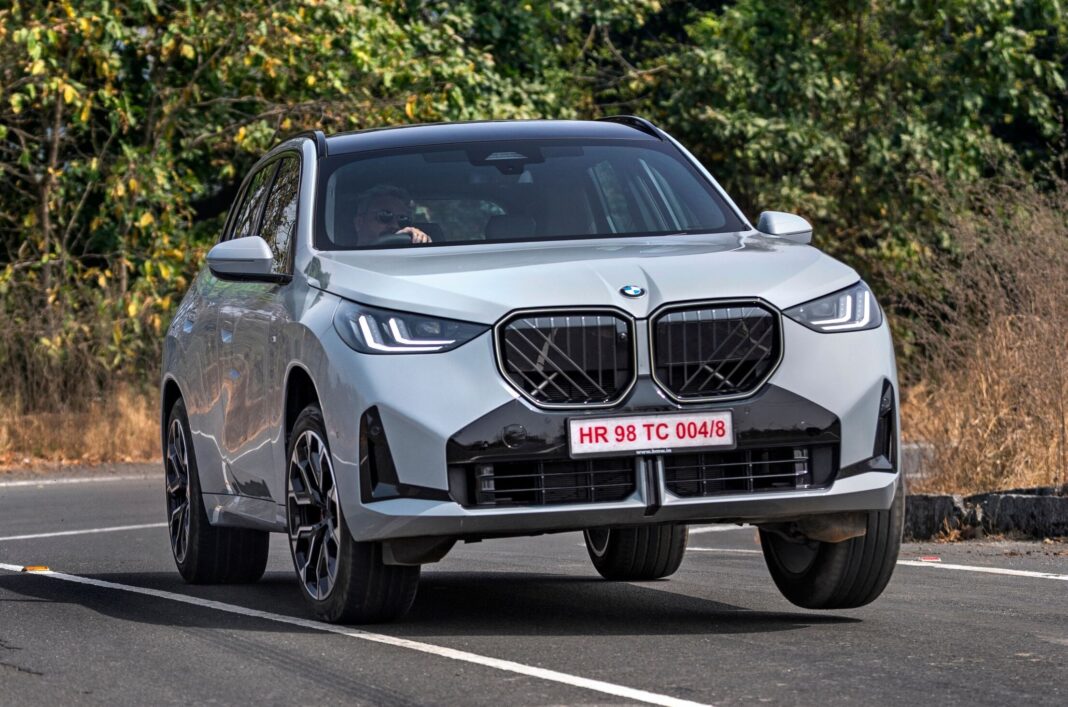
One of the biggest criticisms we levelled at the fourth-generation BMW X3 was that performance from the petrol powertrain felt underwhelming. With just 190hp on tap, the X3 20 xDrive was severely outgunned by the Mercedes-Benz GLC 300 and even the ageing Audi Q5 and simply didn’t feel befitting of a car that had grown both in size and price with this new generation. To claw back the advantage, BMW has now introduced the X3 in 30 guise, bringing a healthy bump in performance, fatter rubber to exploit it, and a few minor tweaks all round. But can this engine propel the X3 to the top of the class? We drove it in and around Mumbai to find out.
BMW X3 30 xDrive Exterior Design and Engineering –
The X3 is one of BMW’s less polarising recent designs, and nothing has changed on that front. With clean lines and flat surfacing, the SUV has an almost monolithic aesthetic, particularly in the new Brooklyn Grey paint shade of our test car. But colour aside, it can be a little hard to tell the 30 trim apart from the lesser 20 variant, which will continue to be sold alongside the 30. All India-spec X3s come with the M Sport package, which adds sportier bumpers and side skirts, but the 30 upgrades to the M Sport Professional pack. This brings a gloss-black surround for the illuminated grille, darker finishes inside the adaptive LED headlights and red brake calipers with M branding.
It also gets larger 20-inch wheels – compared to 19s on the lower variants – with a staggered tyre setup sporting 255-section fronts and fat 285-section rears. At the rear, the arrow-shaped tail-lamps now get a smoked finish and a subtle ‘30’ badge sits on the electrically operated tailgate, which hides a substantial 570-litre boot.
BMW X3 30 xDrive Interior Space and Comfort –
Step inside, and you’ll notice M Sport Pro flourishes such as a metal sill plate, M logo projection from the puddle lamps and the signature M stripe stitched into the seatbelts. The most notable change, however, is that the dashboard and door card uppers are finished in leatherette. The lower trims get recycled polyester, which is hard to keep clean due to its mesh-like texture and doesn’t feel quite premium enough. For now, this leatherette finish is exclusive to the 30 variant and helps the cabin feel more upmarket. That said, the hard plastics lower down still feel out of place at this price point.
The cabin layout is otherwise unchanged, retaining a minimalist feel with the ambient lighting creating a stunning environment at night. The dashboard is almost completely devoid of buttons, with most shortcuts positioned on the centre console alongside the crystal iDrive controller. The front seats are electrically operated and ventilated and are very comfortable, offering a wide range of adjustment. You also get a thigh support extension and side bolsters that can be brought in to hold you better through the twisties.
Rear passengers will appreciate the legroom, headroom and thigh support the bench offers, but the backrest is too upright and cannot be reclined. Seating three abreast is also a challenge due to the tall transmission tunnel. While the sunblinds and third climate zone help matters, the rear-seat experience isn’t as special as the GLC’s, largely because of the amount of hard plastic directly in sight.
BMW X3 30 xDrive Features and Safety –
Packed with features and tech but hampered by an over-reliance on the central touchscreen.
The M Sport Pro pack doesn’t bring any additional features, but the X3 was hardly lacking to begin with. Headlining the list is the massive single-pane panoramic glass roof that floods the cabin with light. Other highlights include an auto park function and BMW’s Digital Key Plus, which lets you use your smartphone as the key. The 15-speaker, 750W Harman Kardon sound system also sounds rather good. An array of cameras and a 360-degree view is a given, but the X3 also allows you to monitor the exterior and interior remotely and record 60-second clips.
Infotainment and instrumentation are handled by a 14.9-inch central touchscreen and a 12.3-inch digital instrument cluster, the latter augmented by a customisable head-up display. While the centre screen is responsive, having the climate controls baked into it is quite distracting. This is compounded by the unnecessary complication of the haptic sliders used to open or close the vents, along with the fiddly directional controls. The iDrive touchscreen UI can also feel confusing at first, but by using a combination of the touchscreen, iDrive controller and shortcut keys on the centre console, it is possible to get used to it.
Safety kit includes eight airbags, ABS, Dynamic Stability Control and a tyre-pressure monitoring system. ADAS features such as adaptive cruise control, lane-keep assist and forward collision warning with brake intervention are also included, and during our drive, these worked well on clearly marked roads without unnecessary interventions.
BMW X3 30 xDrive Performance and Refinement –
Finally gets the performance it deserves to match its refinement.
In 30 guise, the X3 retains the same 2.0-litre four-cylinder turbo-petrol engine, albeit in a higher state of tune. Here it produces 258hp and 400Nm, an increase of 68hp and 90Nm over the lesser 20 trim, and coincidentally exactly the same output as the Mercedes-Benz GLC 300. Unsurprisingly, performance is now far more enthusiastic. In our preliminary testing, we managed a 0-100kph time of 6.11 seconds, and in-gear acceleration is noticeably quicker as well.
The 48-volt mild-hybrid system provides a useful shove of torque low down, helping you dart into gaps in city traffic – something it already does well in the 20 variant. Where the 30 really differs is when you push the engine harder. It feels much punchier through the mid-range and top end, giving the impression that there’s power in reserve – something the 20 can’t quite pull off. Sport mode livens things up further, sharpening responses and even amplifying the engine note through the speakers. It isn’t the most exciting-sounding four-cylinder, but it is very refined, with only a hint of coarseness creeping in at higher revs.
As always, the 8-speed automatic is seamless in its shifts, with a well-judged spread of ratios that keeps the engine on the boil for the most part. A short tug on the left paddle shifter is met with a quick downshift, while a longer pull engages Boost mode, delivering a 10-second surge from the mild-hybrid system.
BMW X3 30 xDrive Mileage and Efficiency –
Official fuel economy figures are yet to be announced.
BMW has not quoted an official fuel-efficiency figure for the X3 30 xDrive. However, the 20 variant is rated at 13.38kpl by ARAI. We expect the 30 to be slightly worse off, given its larger wheels and tyres, as well as the higher state of tune of the engine.
BM X3 30 xDrive Ride Comfort and Handling –
Wider tyres sharpen the already superb handling; adaptive dampers largely preserve pliancy despite the larger wheels.
The biggest impact in this department comes from the wheel and tyre setup. While the 255-section fronts and 285-section rears might feel like overkill for a vehicle in this class – not to mention the eye-watering cost of replacement – there’s no arguing with the grip they provide. Even with a bit of gravel on the road, the tyres and the xDrive system put the power down without fuss.
Outright handling is also improved thanks to the wider contact patch and slimmer sidewalls. Turn into a corner, and the front end reacts with immediacy, while the fat rear tyres find immense traction as you start to feed the power in. Engage Sport mode, and you can feel the whole car firm up as the adaptive dampers tighten, allowing it to corner even flatter. The steering weights up, too, though not as much as I would have liked. While it isn’t the most feelsome, it is sharp and direct, making it easy to place this big SUV with precision.
The downside of the lower-profile tyres is more harshness over rough patches. Hit a bump, and that initial sharpness comes through rather abruptly. As a result, Sport mode for the dampers is best reserved for smooth, winding roads. Everywhere else, Personal (BMW speak for Comfort) mode is the better bet, providing a decent amount of pliancy at low speeds. As speeds rise, the ride settles nicely, with the body remaining flat over undulations and excellent high-speed stability to boot. To sum it up, the X3 was already an engaging drive, and the 30 improves on that further.
BMW X3 30 xDrive Expected Price and Verdict –
Finally has the firepower to take on the Mercedes-Benz GLC 300.
With the 30 xDrive, BMW has finally made amends for not giving the X3 the engine it deserved from the start. Performance is now what you’d expect from a vehicle of this size and class, and the minor enhancements inside and out make it feel more premium. The Mercedes-Benz GLC still feels plusher inside and is more traditionally good-looking on the outside, and with its significant power advantage over the X3 20, it became our default recommendation in this segment. But now that the X3 finally has the power to go toe to toe, perhaps a rematch is in order.
That is, of course, if BMW gets the pricing right. At the time of writing, pricing for the X3 30 xDrive is yet to be announced. We expect it to sit at the top of the range, above the Rs 71.20 lakh 20 petrol and the Rs 73.10 lakh 20d. As mentioned earlier, the petrol 20 will continue as the entry-level model, but with the performance gap being what it is, I’d skip it and go straight for the 30 instead.